
In previous years, amateur radio enthusiasts heavily relied on dip meters as an indispensable tool for circuit testing. These meters, also known as grid dip meters, were variable-frequency oscillators with a coil that could be placed near the tested circuit. When the dip meter's frequency matched the circuit's resonant frequency, a sudden drop in current would show on the meter. However, as of 2024, dip meters have become increasingly scarce.
In this blog post, I will demonstrate how to use an antenna analyzer like the RigExpert or a NanoVNA1 as a grid dip meter.
Find the LC circuit2 resonant frequency
-
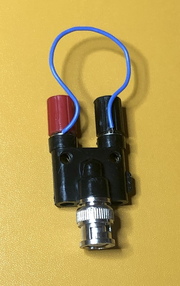
Connect a sensor coil made of one loop to the output port of your RigExpert3 or NanoVNA.
-
Select the SWR graph and set up the frequency sweep.
-
Place the sensor coil coaxially, a few centimeters away from the trap being measured.
-
Initiate the scan. The RigExpert or NanoVNA will display a dip at the resonant frequency.
To illustrate this, I created a small trap using leftover thin coax from another project and an LC circuit using a few turns of enamel wire in parallel with a capacitor.
RigExport Zoom
The images below display the sensor coil placed near the trap and made of thin coax. On the RigExpert screen, we can see the dip and read the resonant frequency at approximately 35.55 MHz.

In the following example, we measure the resonant frequency of a trap for a 20/40 meter QRP antenna. The resonant frequency on this trap is below the 20-meter band at 13.52MHz.

NanoVNA
Now, we measure the same LC Circuits using the NanoVNA with the grid dip meter method. The NanoVNA display shows the dip. After placing the cursor 1 into the dip, we can read the resonant frequency of the LC circuit at 35.60MHz.

The following example shows a resonant frequency of 13.50MHz for the 20/40 meter antenna trap.

Conclusion
The information above might sound familiar to seasoned ham radio operators, but it's a great guide for anyone new to using an antenna tuner or a NanoVNA. This method can really help you get accurate measurements when tuning your trap antenna, especially if you already have an Antenna Analyzer or a NanoVNA.
-
Other methods exist to measure the resonant frequency when using a VNA. I use this method in this article to illustrate how a grid dip meter works. ↩
-
An LC circuit, also known as a resonant or tank circuit, is an electrical circuit consisting of an inductor (L) and a capacitor (C) connected either in series or parallel. ↩
-
I am using a RigExpert in this example, but any antenna analyzer can be used. ↩